
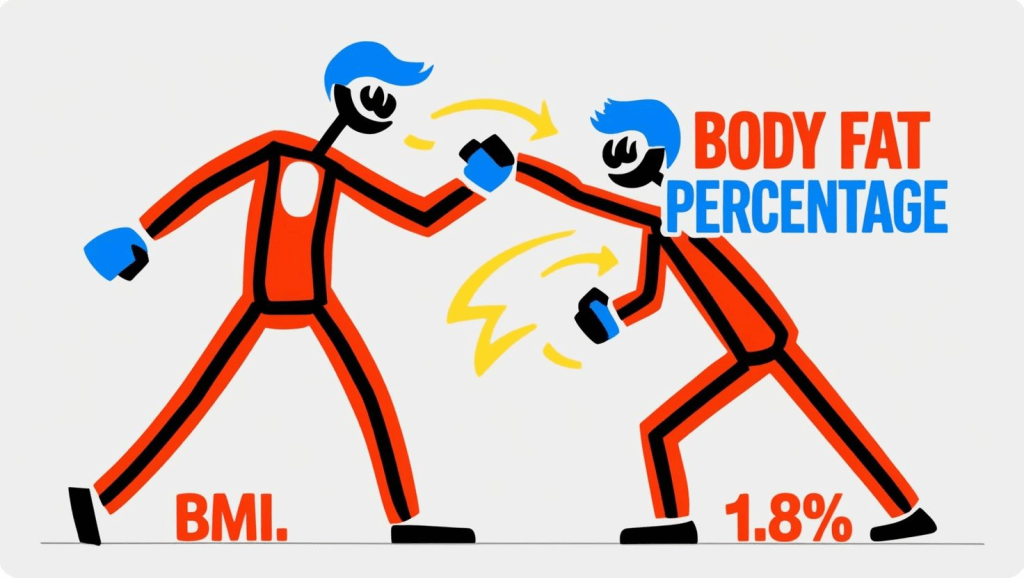
Why Measuring Body Fat is More Accurate Than Using BMI
When it comes to evaluating health and fitness, the Body Mass Index (BMI) has long been used as a quick and easy tool. However, it fails to accurately assess body composition, especially for individuals who are muscular or athletic. Unlike BMI, measuring body fat percentage provides a more precise reflection of one’s health status, helping to distinguish between fat and muscle mass. Here’s why body fat measurements are a better indicator, illustrated with real-life examples.
Understanding BMI and its Limitations
BMI is a simple calculation based on a person’s height and weight. The formula divides a person’s weight in kilograms by the square of their height in meters (kg/m²). While BMI can be a useful tool for the general population to identify potential weight issues, it doesn’t differentiate between muscle, bone, and fat. As a result, BMI often misclassifies athletes, bodybuilders, and muscular individuals as overweight or obese, even when they have low body fat.
Example 1: Mark McGwire – Misleading BMI
Mark McGwire, a former Major League Baseball player, is a great example of someone who would have been misclassified by BMI. Standing at 6’5″ and weighing around 250 pounds during his career, McGwire was a powerhouse on the field. His muscular build, especially his massive arms and shoulders, was a key part of his success as a slugger. However, according to BMI standards, McGwire would be categorized as “overweight” or even “obese.” This is because his weight, though hefty, is largely made up of muscle, not fat.
In reality, McGwire’s body fat percentage would have been significantly lower than the average person. He was an elite athlete, and much of his weight was lean muscle mass that BMI simply doesn’t account for. If his body fat percentage had been measured, it would have revealed a much healthier body composition than BMI suggested.
Why Body Fat Percentage is More Accurate
Body fat percentage directly measures the proportion of fat to lean mass in the body, offering a more accurate picture of health than BMI. Someone with a high amount of muscle mass but low body fat will show a higher weight without the associated health risks of being “overweight” or “obese.”
For example, a bodybuilder or athlete like McGwire, whose body is composed mostly of lean muscle, would have a low body fat percentage, perhaps around 10-15%. In contrast, someone with a higher BMI who carries excess fat may have a much higher body fat percentage, posing a greater risk for heart disease, diabetes, and other health issues.
Example 2: The Rock – Another Case of Misleading BMI
Dwayne “The Rock” Johnson is another example of a celebrity who would be misclassified by BMI. At 6’5″ and weighing around 260 pounds, The Rock is a towering figure with a substantial amount of muscle. According to BMI, he would fall into the “overweight” or “obese” category, despite being in excellent physical shape with a low body fat percentage.
If you were to measure his body fat, it would likely be in the range of 10-15%, which is considered very healthy for a man of his size and age. This example underscores the fact that BMI doesn’t take into account muscle density or fat distribution, making it an unreliable tool for athletes and anyone with a muscular build.
How to Measure Body Fat Accurately
There are several methods available to measure body fat accurately:
- Skinfold Calipers: A trained professional can use calipers to measure the thickness of skinfolds at various body points. These measurements are then used to estimate body fat percentage.
- Bioelectrical Impedance Analysis (BIA): This method uses a small electrical current to estimate body fat. While not as accurate as other methods, BIA is quick and easy.
- DEXA (Dual-Energy X-ray Absorptiometry): This is one of the most accurate ways to measure body fat. It uses low-dose X-rays to differentiate between bone, lean tissue, and fat tissue.
- Hydrostatic Weighing: This method involves being submerged in water to calculate body density, which can then be used to estimate body fat percentage. It’s highly accurate but less commonly available.
The Takeaway
While BMI can provide a broad overview of a person’s weight in relation to their height, it does not account for body composition. Muscular individuals like Mark McGwire and Dwayne “The Rock” Johnson are often categorized as overweight or obese by BMI, despite being in great shape with low body fat percentages. For a more accurate reflection of health, body fat percentage is a far superior measure. Whether you’re an athlete or just someone looking to improve your fitness, tracking body fat provides a clearer picture of your overall health and progress.
Ultimately, the goal is not just to achieve a number on the scale but to build a healthy, strong, and sustainable body. Understanding your body fat percentage will help you make informed decisions about your fitness routine and nutrition, setting you up for long-term success.
 Girded with Strength Fitness
Leave a comment